April 2026
Plans are already underway for our 2026 community events, and we look forward to another great year together. The first event of the year is the Giant Sequoia Wire & Beer Festival on
Saturday May 23 rd . And, the Camp Nelson Volunteer Fire Department Pancake Breakfast is on Sunday May
24 th . We also invite you to stay involved with community events by attending the monthly JMNC Board meetings and the monthly Communities of the Giant Sequoias Board meetings.
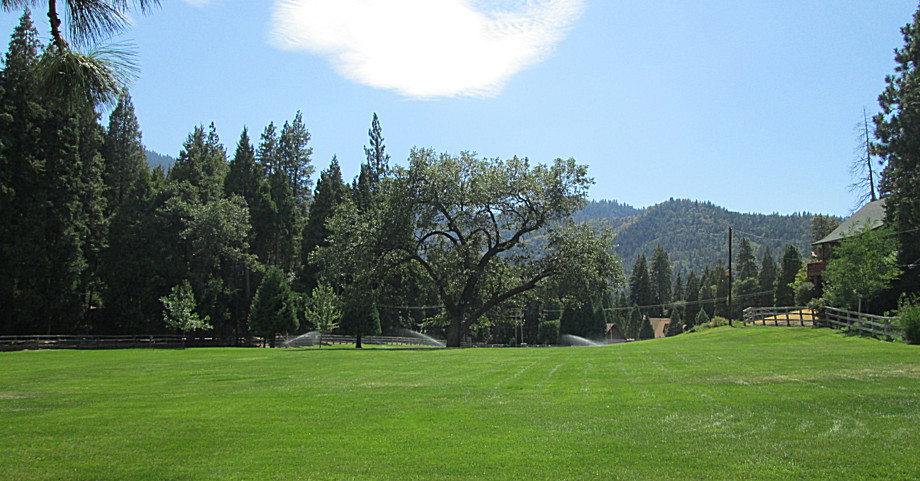
The Meadow Trail begins at the gate by Nelson Drive and Smith Drive. Go inside the gate and follow the signs around the meadow for a half mile stroll. There is a bench at the high side of
the trail for your comfort. If you bring your dogs to the meadow, please clean-up their mess and do not let dogs chase the deer. Thank you.
The Conifers of the Upper Tule region.
Conifers are cone-bearing trees. This group includes the pine, redwood, fir, cedar and spruce.
They grow to be large trees and are found in vast regions of the Northern Hemisphere. Most coniferous trees are evergreens, due to shortened growing seasons. Unlike deciduous
trees, evergreens do not shed their leaves in the fall and are ready to photosynthesize in the spring. The needle-shaped leaves are an adaptation to dry and cold conditions. The needle
shape reduces
surface area to minimize evaporation and exposure to extreme temperatures. These trees in our Sierra Nevada Mountains include;
Ponderosa Pine; grow at 3000-6000 feet elevation; needles are 6-10 inches long in bundles of three; cones are egg shaped 4-6 inches long.
Sugar Pine; grow at 4000-7000 feet elevation; needles are 2-4 inches long in bundles of five; cones are cylindrical/slender 12-20 inches long; grows to be the largest of all pine species and
produces the longest cones of all pine species.
Western White Pine; closely related to the Sugar Pine with similar characteristics; does not grow as big as Sugar Pine and cones are only 5-10 inches long.
Jeffery Pine; grow at 6000-9000 feet elevation; needles are 5-9 inches long in bundles of three; cones are large oval/round 6-8 inches long.
Lodgepole Pine; grow above 6000 feet elevation; needles are 1-3 inches long in bundles of two; cones are small round/egg shape 1-2 inches long.
Tamarack Pine; a sub-species of Lodgepole with very similar characteristics.
Giant Sequoia (redwood); grow in groves above 5000 feet elevation; needles are ½-1¼ inches long in flat sprays on lower branches; needles are shorter, more slender, sharper and not in
flat sprays on higher branches; cones are round/egg shaped 2-3 inches long.
Red Fir; grow at 5000-9000 feet elevation; needles are ¾-1 inch long, sharp and perpendicular to branch on 4 sides; cones are 6-8 inches long.
White Fir; grow at 3000-9000 feet elevation; needles are 1½-2½ inches long, flat, blunt on end, on two sides of branch curving upward; cones are 2-4 inches long, usually only on upper
branches.
Incense Cedar; grow at 1000-9000 elevation; foliage is flattened sprays in dark green. Seed cones are ¾ to 1 3/8” long with four scales arranged on opposite sides.
As members of the conservancy, our common interests include the Meadow, Conservancy Yard, buildings and the RV Park. It takes the dedication of volunteers who serve willingly to insure that
we preserve and maintain these areas for the enjoyment and use of the community and visitors.
Thank you to everyone that continuously serves. If you are interested in helping, contact any JMNC Board Member. We work closely with Communities of the Giant Sequoias, Volunteer Fire
Department, Camp Nelson Women’s Club, Camp Nelson Chapel and the local businesses to promote all the communities in the Upper Tule area.
The John M. Nelson Conservancy is a California 501-C3 Public Benefit Corporation and your donation is deductible on Federal and State income tax returns; ID #68-0066225. It is hoped that
you feel we are an organization worthy of your support. You may make a donation on our website (johnmnelsonconservancy.org) or mail your donation to: 801 Highway 190, Box 110, Springville
CA,
93265. Should you have any questions, please contact any Board Member listed on the website contact page.
The Camp Nelson RV Park is open. If you have friends or relatives that enjoy RVing/camping, invite them to make their reservations for the upcoming months. Call 559.542.2471 for
information.
Also, visit “Camp Nelson RV Park, CA” on Facebook.
We invite you to check the current weather conditions in real time by using the Weather Underground app on your smart phone or go to www.wunderground.com on your computer. Our station’s
designation is “KCACAMPN10”.
Visit our website to volunteer, make a donation, read the monthly Conservancy Article, buy a memorial brick, or purchase a copy of “The Tule River Middle Fork and its People” written
by Malcolm Sillars. Read about the Tule River communities on the middle fork and see for yourself the
history of this wonderful mountain home for many people. Here is an excerpt from Chapter Nine of the book for your enjoyment:
Chapter Nine; Kramer’s Sheep Meadow, Quaking Aspen, and Pete’s Ponderosa.
“At about the same time as the Harts and Bowden were scaling back on the fox farm activity at Kramer Meadow the pack station from Camp Nelson was moved to Freeman Creek (Quaking Aspen) off
the end of Highway 190 and sold by the McCombers to Owen Rutherford. Albert Jones and Ray Hansen, who had a sporting goods store in Hanford, took out a special use permit from the U.S.
Forest Service to build and run a store near the pack station. In 1949 the same store was moved to the north side of Highway 190 across from the pack station at the lower end of
Quaking Aspen Meadow. Across the road from the Quaking Aspen Store was a primitive campground, where
Boy Scout troops from Camp Whittset, over the ridge near Johnsondale, would camp overnight on the Silver Knapsack pack trip. They and other campers in the campground would visit the
store.”
Page 128.
For more current information and events, you can follow us on Facebook at
www.facebook.com/jmnconservancy.
We invite you to attend our monthly Board meetings on the second Saturday of each month at 8:00AM in the Conservancy building; 388 Smith Drive, Camp Nelson. The next meeting is April
11, 2026.
Check-out the web page at;
www.johnmnelsonconservancy.org
Mailing Address is; 801 Hwy 190, Box 110, Springville, CA 93265
Respectfully Submitted, April 2026.
Dan McFadzean, Director; JMNC. Email; mcfadzeand@yahoo.com; phone.661.978.4679
ere's where you can enter in text. Feel free to edit, move, delete or add a different page element.
 Print
Print 